Artificial Geospatial
General Intelligence
Multi-agent intelligence for the physical world
Traditional production software is built to be run by people: humans perform every operational activity, make every judgment, and the software assists. AG2I inverts that model. It is the operational layer itself — an unlimited, configurable org chart of specialist agents, each expert in its own discipline, orchestrated by frontier reasoning models the way a production manager runs a department. An entire mapping company in code. On a block of multi-vantage aerial data, AI-automated production reaches 0.748 px and 0.080 m in three dimensions on withheld check points, carried through orthorectification to a byte-verified delivery. Any size of project, any sensor, any dataset — cutting manual labour by roughly 80 % and making the expertise a company already has five to ten times more productive. AG2I is the operational layer — the future of AI-automated geospatial production. What is geospatial general intelligence? →
The first AI-native geospatial processing system.
Conventional geospatial software forces every dataset to conform to a fixed, rigid workflow. AG2I inverts that relationship. By embedding Anthropic's Claude Code directly into a purpose-built, million-line geospatial codebase, the system reasons about each dataset and composes the pipeline to fit it — automating the analyst's judgment rather than merely executing fixed steps. The result is a general capacity to process anything geospatial: aerial, oblique, LiDAR, satellite, terrestrial, or street-level.
Claude Code at the core
An integrated reasoning agent interprets the data, selects methods, and orchestrates the toolchain — turning an expert workflow into an automated one.
The system adapts to the data
Both the command-line engine and the GUI reconfigure themselves around each dataset's geometry and sensor model — not the other way around.
Built from the ground up
More than a million lines of original, modular code — engineered to expose the full power of the most capable geospatially trained AI available.
Survey-grade accuracy, AI-automated.
Beneath the intelligence layer sits rigorous geodetic science: aerotriangulation, trajectory compensation, and bundle adjustment at scale — the same core whether the sensor flies at five thousand metres or twenty. The system models time-sync offsets, lever-arm geometry, and platform motion to resolve raw imagery and point clouds to true, reportable accuracy, and carries that accuracy unbroken from the airborne sensor to the ground. Every number we publish is measured against withheld control or an independent sensor — never asserted.
Aerotriangulation
The foundation of aerial sensor processing: high-redundancy, multi-ray tie-point networks solved by robust bundle adjustment across thousands of exposures and millions of observations — sub-pixel in the image, centimetre-level on the ground, on blocks a conventional shop budgets weeks for.
Trajectory Compensation
Refinement of platform trajectories through time-synchronization and lever-arm correction — the basis for oblique triangulation and air-to-ground accuracy transfer. From a raw delivery and nothing else, the system recovers where every camera was and where it looked, to centimetres of the aircraft's own record.
Adaptive Automation
An AI-automated, adaptive CLI — with a GUI designed around the dataset — that configures and executes every processing stage without manual intervention, and refuses rather than guesses: a stage that cannot prove its own result stops the line instead of passing the problem downstream.
A unified, modular processing stack.
Each engine is an independent module with a rigorous methodological basis; together they compose a continuous pipeline from raw acquisition to interactive, machine-readable 3D models.
OpenStereo
The aerotriangulation and stereo core: high-redundancy multi-ray tie-point networks solved by robust bundle adjustment, dense multi-view stereo, and the surface and terrain models the rest of the line is built on. 0.748 px over 2.45 million observations on a 1,248-image block; 0.080 m in three dimensions on withheld check points.
OpenLiDAR
Full raw-to-product LiDAR processing — raw airborne and terrestrial returns through calibration, strip adjustment, classification, and DSM/DTM production to finished deliverables — with hierarchical octree indexing that streams billion-point datasets interactively.
OpenScan
A native LiDAR classification and editing workstation with no third-party CAD dependency — ground, building, vegetation and noise separated by progressive TIN densification and spectral indices, driven by a headless macro engine that runs an ordered routine pipeline across a whole tiled project with halo buffering, so every tile classifies as though it were the entire strip. On a dense-urban block it separates buildings at 0.997 precision.
OpenMosaic
Orthorectification, radiometric balancing, seamline networks and delivery tiles. Seams are routed on the best evidence the block carries: classified LiDAR where it exists, otherwise the DSM/DTM surfaces and the imagery's own radiometry, keeping cuts on the ground and off buildings and elevated structure. Every delivered file is checksum-verified at the far end.
DroneAT
Drone aerotriangulation from the raw delivery: mount conventions and exposure clocks measured from the data, the camera self-calibrated inside the adjustment, and the on-board LiDAR coloured through the resulting orientation — verified against the scanner and against state survey control.
OpenMultiAgent
An orchestrator–worker multi-agent system that plans, dispatches, and verifies large-scale geospatial production — a synthetic workforce that runs the whole pipeline, adapts when a verifier fails a stage, and escalates rather than passing work through silently.
OpenGlobe
A WebGL virtual globe rendering orthoimagery, terrain, vector HD maps, and point clouds within a geodetically rigorous reference frame.
OpenGeoCad
A geospatial CAD platform — a full CAD entity model with first-class coordinate reference systems, fed live from the stereo plotter and the point cloud.
OpenVoxelite
Volumetric fusion of orthoimagery, LiDAR, and HD Map data into a discretized voxel field supporting spatial query and occlusion reasoning — and, as a control surface of known accuracy, the reference other datasets are registered to.
OpenFeatureX
AI-automated geospatial feature extraction from high-accuracy datasets, purpose-built for GPU architecture.
OpenLineWorks
Geometric registration of vector and raster data via thin-plate-spline warping and iterative correspondence refinement under non-rigid deformation.
OpenNavHD
High-definition mapping and positioning framework providing the lane-level geometric substrate for navigation and dead-reckoning.
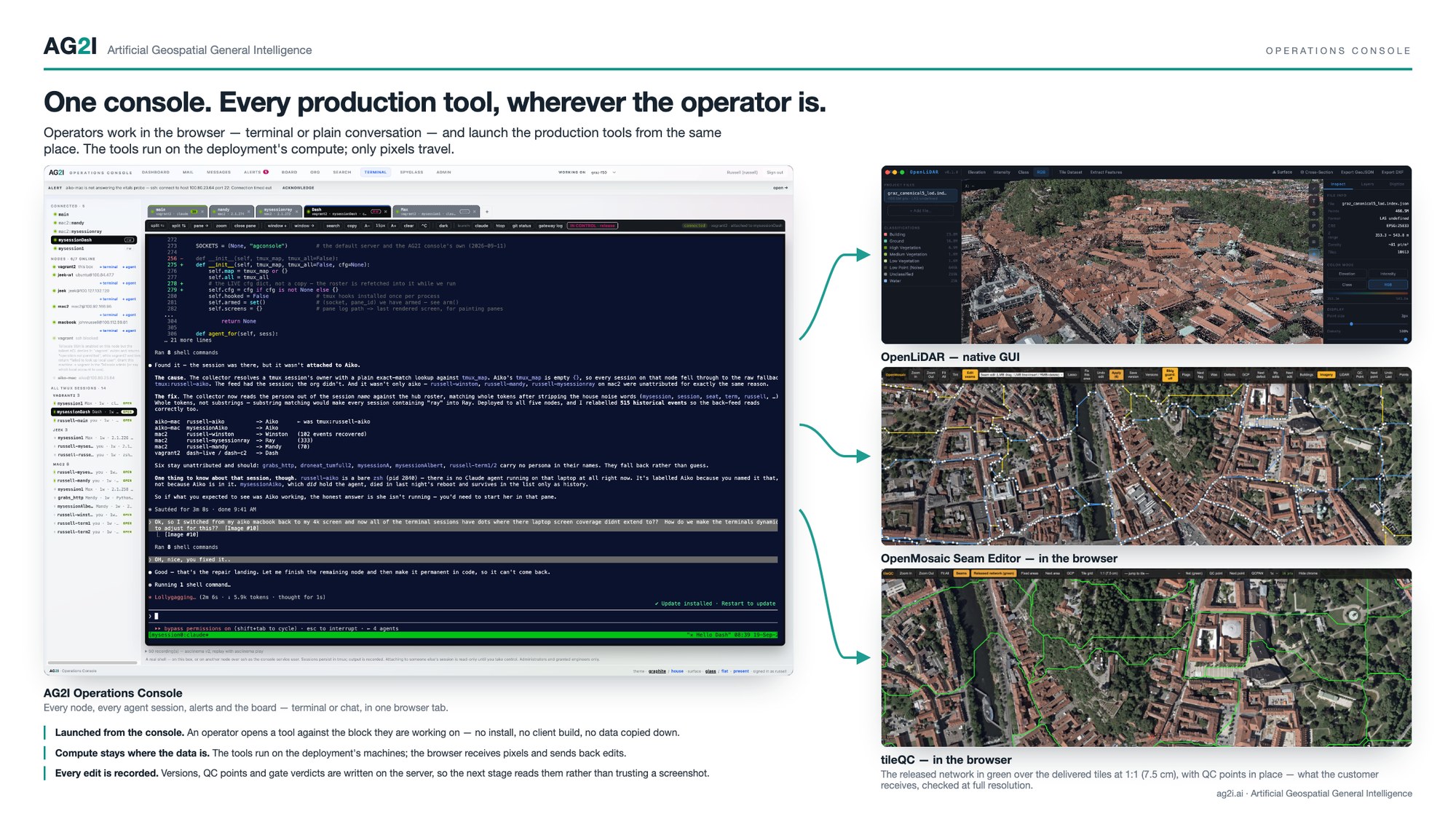
One console. Every production tool.
Production capacity is compute capacity.
An AG2I deployment is not a seat count. The line runs headless on Linux, on customised AG2I virtual machines, so throughput scales with the compute placed behind it rather than with the number of people hired to drive it. Add machines and the same organisation of agents runs more blocks in parallel — the work expands, the staffing does not.
Operators never need the terminal. The interactive production tools and the three-dimensional visualization are rendered server-side and served to the browser, so a reviewer anywhere in the world works on the full block at full resolution over an ordinary connection. The Operations Console puts the whole deployment in one place, and lets an operator speak to the agent team the way they prefer — command line for those who want it, plain conversation for everyone else.
The system can also be deployed disconnected. In an air-gapped estate the reasoning layer runs on-premise against a local open-weight model, with no traffic leaving the customer's network — the production algorithms are ours and run the same either way.
- Headless Linux, customised AG2I VMs — standard virtual machines, no special hardware.
- Capacity scales with compute — more machines, more blocks in parallel, same team.
- Browser-delivered production — server-side rendering puts the full dataset in front of an operator anywhere.
- One Operations Console, two languages — terminal CLI or chat, talking to the same agents.
- Air-gapped deployment — a local model runs the line where nothing may leave the network.
We choose models on evidence, not on brand.
Ten models were put through the same fifty-three production situations drawn from real work, none of which any of them had been tuned against. Two things were scored: how much routine instruction each carried out correctly, and how often it stopped and handed a situation to a person when a person was required. On routine competence the field is tight — open models match the largest commercial ones. On judgment it is not tight at all, and judgment is what a production line cannot do without. The bench is standing, not a one-off: every time a novel open-source model is released it is run through the same situations, and a model earns its place in the deployment on that measurement or does not enter it.
That measurement decides the work each model is given. Claude Fable 5.1 and Claude Opus 5 carry AG2I's own development and the production determinations — the judgment calls a department head makes: what a dataset needs, why a solution is wrong, whether a block is fit to deliver. Claude Haiku 4.5, the least expensive of them, carries the repetitive execution it already leads the field on. And the assignment is not fixed: the Operations Console sets which model each agent runs at any moment, so a deployment can be retuned for cost, for speed, or for the hardest block of the year without touching the production code.
Swipe the chart sideways to read every model.
| Model | Routine | Handed over |
|---|---|---|
| Claude Haiku 4.5Anthropic | 97.0% | 100% |
| Claude Opus 5Anthropic | 93.9% | 100% |
| Claude Fable 5.1Anthropic | 93.9% | 100% |
| Claude Sonnet 5Anthropic | 90.9% | 95% |
| Qwen3.6-27BAlibaba | 97.0% | 90% |
| Mistral-Small-2603Mistral AI | 97.0% | 85% |
| Qwen3.6-35B-A3BAlibaba | 97.0% | 80% |
| Qwen3-14BAlibaba | 90.9% | 90% |
| Qwen3-8BAlibaba | 87.9% | 80% |
| Mistral-7B v0.3Mistral AI | 87.9% | 30% |
Fifty-three production situations, September 2026. The horizontal axis is routine instructions carried out correctly; the vertical axis is the share of stop-situations handed to a person. The smallest Anthropic model led the field on routine work and missed no stop-situation at all — so the reliability a production line needs is not the price of the largest model. Open models reaching the same routine competence are what make a disconnected, on-premise deployment practical, with escalation to a person where the measurement says they are weaker.