Facade Measurement by Stereophotogrammetry on Oblique Image Pairs
On a precisely aerotriangulated Vexcel UltraCam Dragon block, stereophotogrammetric measurement is not limited to conventional nadir overlaps. Using OpenStereo's multivantage viewer, two forward-looking oblique frames (Forward 203 and Forward 204) are fused into a red–cyan anaglyph stereo model in which building facades — windows, dormers, cornices, foreshortened or occluded in nadir imagery — are measured feature by feature. The capability rests on the block's fully automated aerotriangulation — computed hands-off, with no manual tie-pointing and no operator in the loop: image σ₀ of 0.64 px and independent check-point RMS of 0.257 / 0.080 / 0.254 m (X/Y/Z); on the measured facade point the floating mark closes to the digital surface model at ΔZ 0.00 m.
1. Data and task
The data is the publicly distributed Vexcel UltraCam Dragon 4.1 five-head oblique block (four oblique + one nadir RGBI) over Graz, Austria — the same block as AG2I's aerotriangulation accuracy study; ETRF2000, UTM zone 33N (EPSG:32633). The task here is different: rather than report block accuracy, it is to measure features on the side of a building directly from the imagery, in stereo. Two forward-looking obliques, Forward 203 and Forward 204, are used; display is a red–cyan anaglyph with the floating mark referenced to the digital surface model (DSM).
2. Stereo on arbitrary pairs, and why facades need it
A three-dimensional point is recovered as the intersection of the collinearity rays cast from two or more images of known interior and exterior orientation. The classical near-vertical pair — parallel axes, modest base-to-height ratio — is one well-conditioned case; the underlying space intersection places no restriction on viewing geometry. Any set of oriented rays observing the point yields a solution.
This matters because a vertical building wall is nearly parallel to the line of sight in nadir imagery: the facade is foreshortened to a handful of pixels and is largely occluded by the roof. Window heads and sills, balconies, string courses, signage and ornament are only resolvable in frames that view the wall obliquely. Measuring them therefore requires a stereo model formed from oblique frames — a configuration that workstations built around fixed nadir strips do not support.
3. The enabling condition: aerotriangulation precision
Convergent oblique pairs have strong intersection geometry — a large convergence angle yields a well-conditioned height — but they are unforgiving. Any error in exterior orientation, or any uncompensated lens distortion, maps directly into residual y-parallax and a measurement bias. The pair fuses cleanly under the stereoscope, and the floating mark sits on the surface, only if every frame's orientation is mutually consistent to a fraction of a pixel. The Dragon block's fully automated, self-calibrating adjustment — run end to end from raw inputs, no operator in the loop — provides exactly that:
| Metric | AG2IIndependent | Reference |
|---|---|---|
| Image σ₀ (std. dev. of unit weight) | 0.64px | 0.82 px |
| Independent check-point RMS (X / Y / Z) | 0.257 / 0.080 / 0.254m | — |
| Self-calibrated focal vs factory | < 0.025mm | factory |
Full figures in Independent Aerotriangulation of a Vexcel UltraCam Dragon Block. These are the reason an arbitrary frame pair can be measured at all: the block behaves as one coherent bundle, every frame registered to every other.
4. The measurement
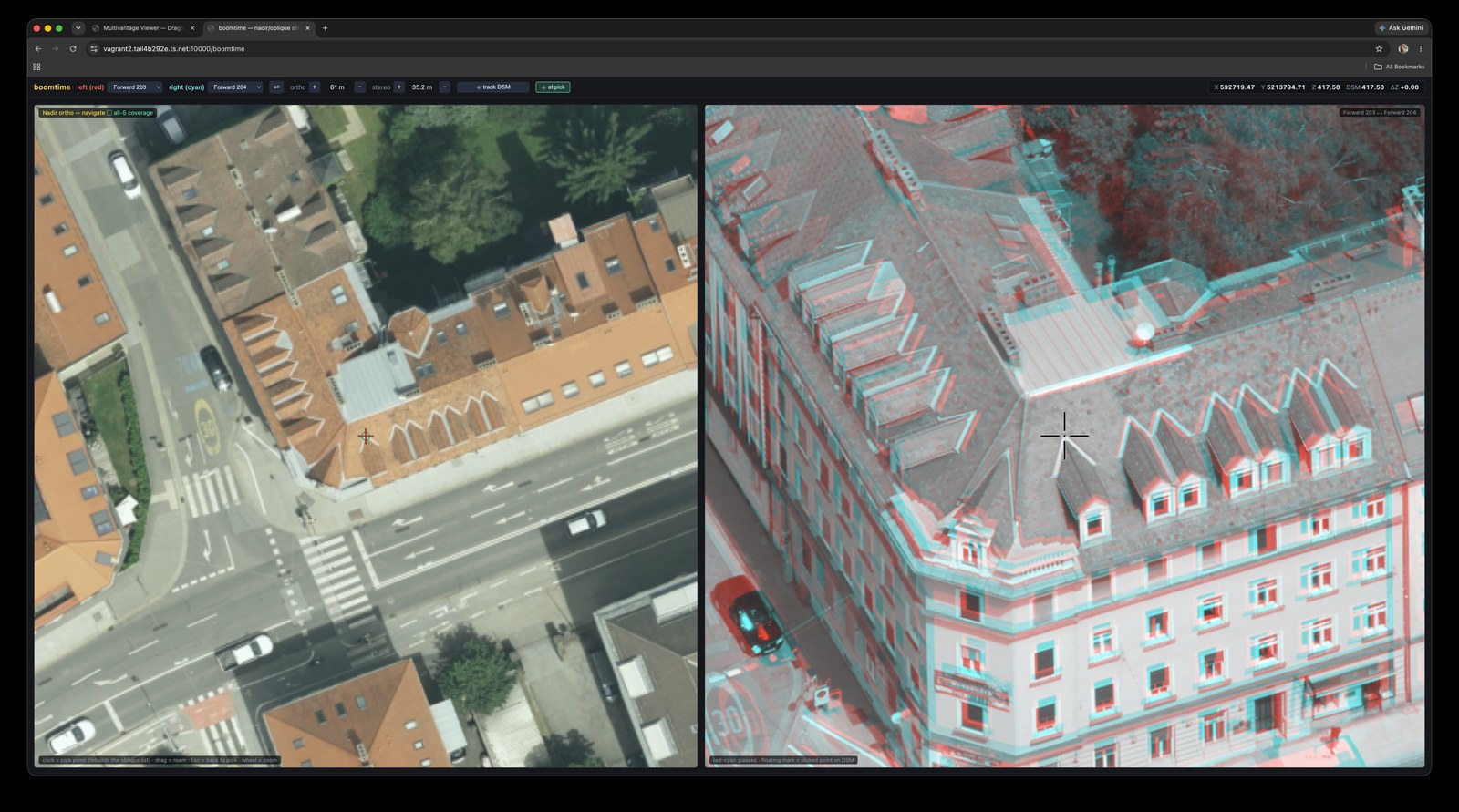
With the floating mark placed on the facade, the viewer returns the point's coordinate and its height relative to the surface model:
| Quantity | Value | — |
|---|---|---|
| Stereo pair | Fwd 203 / Fwd 204 | — |
| Easting (X) | 532719.47m | — |
| Northing (Y) | 5213794.71m | — |
| Elevation (Z) | 417.50m | — |
| Floating mark to DSM (ΔZ) | 0.00m | — |
The mark closes to the digital surface model to 0.00 m in height, confirming that the two obliques register to the same surface the nadir solution defines — the model is metric, not merely a visualization.
5. Conventional stereo versus OpenStereo multivantage
| Capability | Conventional nadir stereo | OpenStereo multivantage |
|---|---|---|
| Eligible image pairs | fixed nadir strip overlaps | any frames observing the point |
| Convergent / oblique pairs | not supported | supported |
| Facade / vertical-surface measurement | no (foreshortened, occluded) | yes |
| Limiting factor | strip geometry | AT precision (sub-pixel orientation) |
| Floating-mark reference | stereo model | model and DSM (ΔZ readout) |
Because the orientation of every Dragon frame is solved to sub-pixel mutual consistency, stereo measurement is no longer confined to the roofscape captured by nadir strips. It extends to the full building envelope, including vertical surfaces, with no specialized facade-capture flight and no per-pair manual relative orientation. The viewing geometry is arbitrary; the achievable accuracy is bounded by the fully automated aerotriangulation solution, not by the camera configuration.
6. Report
The full technical report is available on request: contact AG2I.
Study data: Vexcel UltraCam Dragon 4.1 demonstration block — Graz, Austria (publicly distributed). Contact: info@ag2i.ai.